- Get link
- X
- Other Apps
.png)
At the start of this New Year, my husband quietly began a gentle Tai Chi routine and invited me to join him. It’s simple — five movements, repeated five times, with slow breathing — and takes only a few minutes. He took to it immediately and even added warm-ups. I, on the other hand, noticed some stiffness in my neck and shoulders while my hips and back felt just fine. That got me wondering: Why is Tai Chi suddenly everywhere for people over 55? And does it really shape us up the way the ads promise?
But what’s actually true? And what’s just clever advertising?
Let’s take a balanced look.
What Tai Chi Is (and Where It Came From)
Tai Chi (Tai Chi Chuan) began in China several centuries ago — most
historians trace it to the 1600s in Chen Village, Henan province. It
developed as a martial art rooted in Taoist philosophy, emphasizing
balance, flow, breath, and internal energy (often called “qi”).
Originally practiced by martial artists, elders, and scholars, it slowly
evolved into a health practice. In China, it became common to see groups
of adults — many retired — practicing in parks at sunrise.
When Tai Chi Came to North America
- Tai Chi began gaining attention in North America in the mid-20th century:
- 1950s–60s: Chinese masters began teaching in San Francisco, Vancouver, and New York.
- 1970s–80s: Interest grew alongside yoga and meditation movements. I have a cousin who was a health-conscious massage therapist who did Tai Chi and got his mom, my Auntie, into a regular practice of Tai Chi to keep her fit and healthy.
- 1990s onward: Research began examining Tai Chi for fall prevention, arthritis, and stress reduction in older adults. In the early 90s, I recall checking into a Tai Chi introductory class in our neighbourhood. I felt gawky and uncoordinated in my movements, and I thought I would look into it at another time. That "änother time" occurred in the mid-90s at my workplace where I was a social worker and one of my tasks was facilitating support groups.Someone set up an appointment wherein I took a group of women over to a nearbyriverside park where we joined an amiable Tai-Chi Master while he did his afternoon regimen. He was probably in his late 70s, barefoot and lithe. We comfortably followed in his footsteps, so to speak on that memorable sunny, calm summer day. That was the last time I "did" any public Tai Chi.
- Today, Tai Chi is offered in community centers, seniors’ programs, rehab clinics, and wellness classes across Canada and the U.S.My husband recently dropped by an open house in our local community hall. It was full of people-- mostly over 55-- who belonged to a large group that meets regularly to do Tai Chi.
Why It’s Marketed to People Over 55
There are practical reasons this age group is a natural fit:
1) It’s low-impact
No jumping, no heavy lifting, and minimal strain on joints.
2) It improves balance
Falls are a major concern after midlife; Tai Chi trains slow, controlled
movement.
3) It builds gentle strength
Muscles engage continuously, but without the shock of traditional
workouts.
4) It supports stress regulation
Breathing + movement calms the nervous system.
5) It’s accessible
You can do it in a living room, backyard, or park — no equipment
needed.
Because of this, health programs, insurers, and senior wellness campaigns
often promote Tai Chi as a “safe entry point” to regular movement.
If you find this article is an enjoyable read, you might also find value in
other health-encouraging articles
Organic Granny
has written like: Granny Does A Dopamine Detox
(the post you are reading right now is a follow-up),
Famous Introverts Who Changed The World or
Intermittent Fasting Insights.
Why You Might Feel Shoulder and Neck Stiffness
I definitely felt a lot of crinks and twinges in my neck and shoulders
over the first weeks. Apparently, this is a pretty common
experience..
Tai Chi emphasizes posture, arm carriage, and head alignment — areas many
of us unconsciously tense. Early soreness can come from:
- Holding arms elevated longer than usual
- Engaging postural muscles that are rarely used
- Subtle tension while learning new movements
- Moving slowly (which can actually feel harder than moving quickly)
- If back and hips feel fine, that’s a good sign your core and lower-body mechanics are adapting well.
- movements become more relaxed
- breathing deepens
- muscle coordination improves
- Gentle warm-ups (like my husband added) often help tremendously.
Does Tai Chi Burn Belly Fat?
Here’s the honest answer: it can help — but it’s not a rapid fat-loss
exercise.
What it DOES do:
- Encourages daily movement consistency
- Improves metabolism modestly
- Reduces stress hormones (which influence belly fat storage)
- Builds muscle endurance
- Supports better sleep and digestion
Over months, these changes can lead to gradual body trimming —
especially if paired with balanced eating and walking.

|
| Click to learn more |
What Tai Chi DOESN’T do:
- Rapidly burn calories like jogging or cycling
- “Spot reduce” belly fat
Think of Tai Chi as a metabolic stabilizer, not a fat-melting workout.
Many people slim slowly over 6–12 months because it helps them stick
with movement consistently.
Those Slim “Older” People in Tai Chi Ads — Real or AI?
A mix of both.
Real:
- Many lifelong Tai Chi practitioners remain very lean and mobile into their 70s and 80s.
- In Chinese culture, daily movement and lighter diets contribute to slimmer aging populations.
Marketing reality:
- Advertisements often use unusually fit older models.
- Some images are enhanced or AI-generated.
- Lighting, posture, and camera angles create an impression of dramatic results.
- Tai Chi improves function first — appearance follows gradually, not magically.
How Tai Chi Supports the Body
Tai Chi works like a gentle “systems tune-up.”
Nervous system
Slow movement and breath reduce stress signals and promote
calm.
Heart & circulation
Continuous motion improves blood flow without strain.
Joints
Lubricates joints through controlled range-of-motion.
Muscles
Builds endurance in stabilizing muscles (core, shoulders,
hips).
Digestive system
Relaxation and movement support regular digestion.
Brain health
Learning sequences strengthens memory, coordination, and
focus.
This is why many doctors now recommend it for aging well — not as a
cure-all, but as a foundation practice.
Is Tai Chi “Soft Exercise”?
Yes — but “soft” doesn’t mean ineffective.
It’s best described as:
👏restorative
👏functional
👏sustainable
👏cumulative
Over time, consistency matters more than intensity.
Calming Herbal Teas After Tai Chi ☕
Hydration and relaxation pair beautifully with a gentle practice.
These teas are soothing, pleasant, and supportive without being
heavy.
1) Lemon Balm + Mint Calm Tea ☕
Fresh lemon balm leaves
A few mint leaves
Hot water
Optional: slice of apple
Calms the nervous system and tastes fresh and uplifting.
2) Ginger-Fennel Digestive Tea ☕
Thin slices of fresh ginger
1/2 tsp fennel seeds
Hot water
Supports circulation and digestion after movement.
3) Chamomile + Rose Petal Evening Tea ☕
Chamomile flowers
Dried food-grade rose petals
Hot water
Gentle, fragrant, and relaxing — ideal if Tai Chi is done near
evening.
The Bottom Line
Tai Chi isn’t a miracle fat burner, and the ads can oversell visual
transformation.
But it is one of the most sustainable movement practices for
aging bodies:
😇improves balance
😇supports joint health
😇reduces stress
😇encourages consistency
😇may lead to gradual trimming over time
And perhaps most importantly, it’s something many people
actually keep doing.
That alone makes it powerful.
Your shared thoughts and experiences are very appreciated.
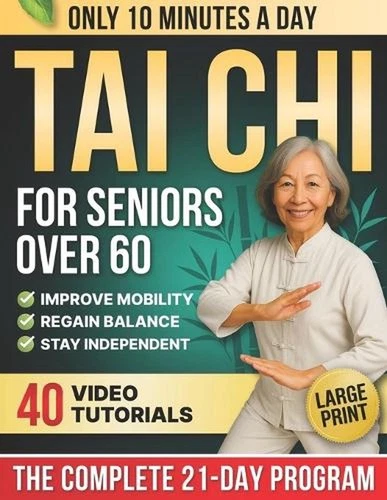
Curious about Tai Chi? Books and magazines can gently guide you into this slow, mindful practice — supporting balance, calm, and graceful movement at any age. Click the image to explore available Tai Chi reading on eBay.
(eBay affiliate link. We receive a commission for qualified purchases.)
Browse Tai Chi Books & Guides at eBay🥤 Article and photos © 2026 Cynthia Zirkwitz | Organic Granny
Please share the link, not the full article — thanks for supporting independent writers!
Nourishing life with integrity, simplicity, and compassion at Organic Granny.
Comments
Post a Comment
Organic Granny really appreciates your thoughtful comments!